

Chapter 2: Your Practice Authority
Find out, from the statute and board rules, what your state lets you do as a PMHNP, under what conditions, and record it on a dated worksheet you can defend.
Sample chapter from The PMHNP Private Practice Launch Guide (Credentik, Inc., 2026 Edition). Educational information only; not legal, tax, compliance, clinical or financial advice. Examples are fictional. Verify current rules with the agency, payer or your own professional advisers.
Before you choose an entity, a logo or an EHR, you need to know what your state permits. Practice authority decides whether you need a physician relationship, whether you must complete supervised hours first, and, in some states, whether the kind of practice you want fits the category the law allows. It is the foundation every other chapter builds on.
This chapter does not tell you your state’s law. It shows you how to find it, how to record it, and how to keep that record honest. The state examples are dated snapshots, not models for other states.
In this chapter you will:
- Understand the AANP practice categories and their limits.
- Separate licensure, population focus and national certification.
- Identify transition-to-practice and collaboration requirements.
- Build a practice-authority worksheet with sources, effective dates and checked dates.
- Work through three dated state examples: Florida, Iowa and Minnesota.
Start with the map, then leave it
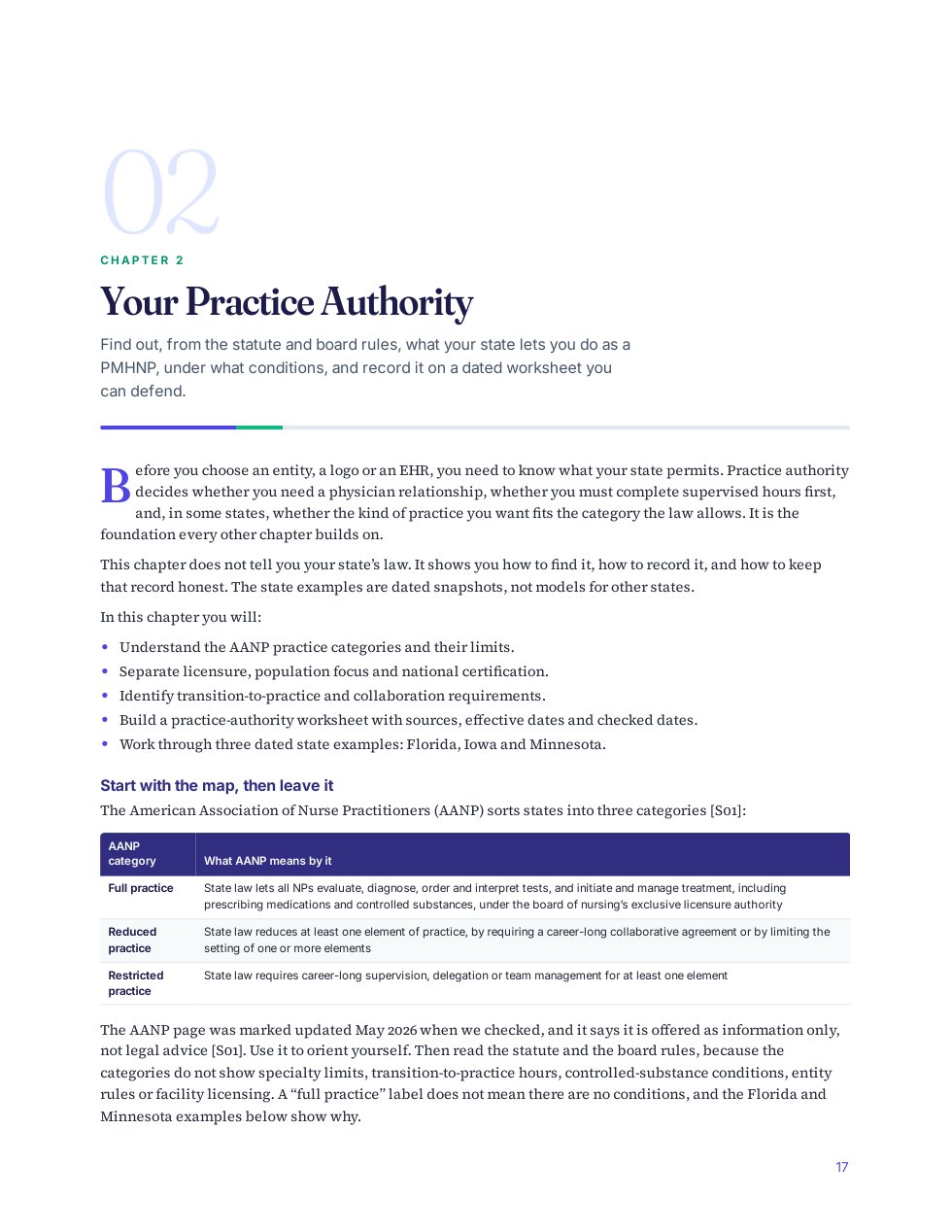
The American Association of Nurse Practitioners (AANP) sorts states into three categories [S01]:
| AANP category | What AANP means by it |
|---|---|
| Full practice | State law lets all NPs evaluate, diagnose, order and interpret tests, and initiate and manage treatment, including prescribing medications and controlled substances, under the board of nursing’s exclusive licensure authority |
| Reduced practice | State law reduces at least one element of practice, by requiring a career-long collaborative agreement or by limiting the setting of one or more elements |
| Restricted practice | State law requires career-long supervision, delegation or team management for at least one element |
The AANP page was marked updated May 2026 when we checked, and it says it is offered as information only, not legal advice [S01]. Use it to orient yourself. Then read the statute and the board rules, because the categories do not show specialty limits, transition-to-practice hours, controlled-substance conditions, entity rules or facility licensing. A “full practice” label does not mean there are no conditions, and the Florida and Minnesota examples below show why.
Licensure, population focus and certification are separate facts
Three things are often blurred together:
- Your APRN license (or recognition) from the state board. This is what authorizes practice.
- Your population focus. The national Consensus Model describes four APRN roles and six population foci, one of which is psychiatric/mental health [S15-07]. Your education and certification are in one focus, and many states tie your scope to it. Iowa’s board, for example, says ARNP practice is based on educational background, population focus and national certifying body standards [S19-02].
- National certification. The American Nurses Credentialing Center (ANCC) awards the PMHNP-BC credential. Its eligibility requirements include an active RN license, a PMHNP (across the lifespan) graduate degree or post-graduate certificate from an accredited program, at least 500 faculty-supervised clinical hours, and graduate courses in advanced physiology/pathophysiology, health assessment and pharmacology. The credential is valid for five years [P02-01].
Record each separately, with its own number, issue date and expiration date. Payers and boards will ask for each one.
Watch out
States are not uniform in how they apply the Consensus Model [S15-07]. Do not assume that a certification accepted in one state, or a scope permitted in one state, carries over to another.
Transition-to-practice and collaboration
Transition-to-practice requirements make an APRN practice for a set period under collaboration or supervision before practicing without it. When you read one, record:
- The number of hours or years, and the window in which they must be earned.
- Who may supervise or collaborate (physician only, or also an experienced APRN).
- Setting limits, if any.
- How the hours are documented and reported, and whether hours from another state count.
- Whether the requirement applies to all practice or only to some services.
Collaboration and supervision requirements may last a whole career. Record whether a written agreement or protocol is required, what it must contain, where it must be kept or filed, any limits on how many APRNs a physician may work with, and whether controlled-substance prescribing carries extra conditions (Chapter 3).
The practice-authority worksheet
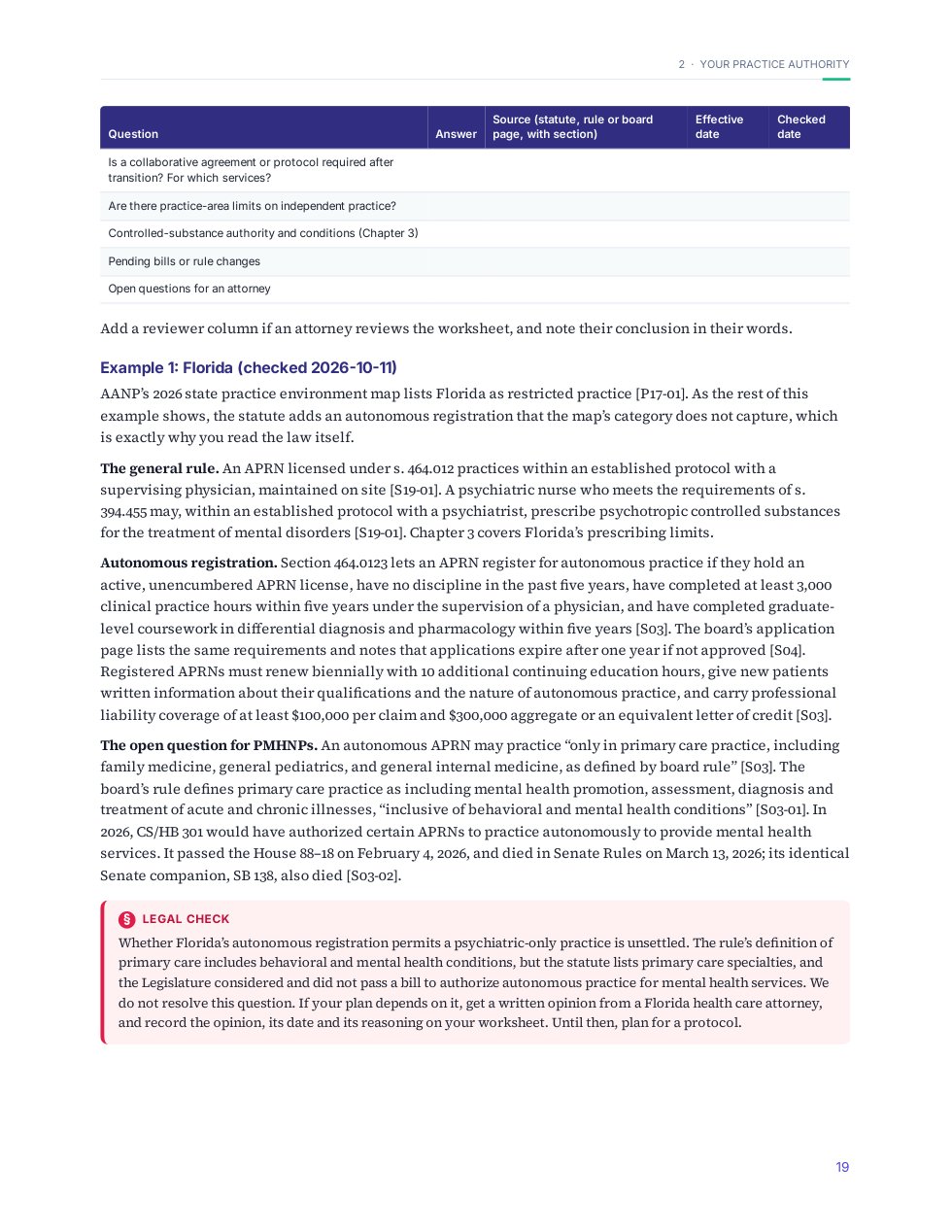
Use one worksheet per state where you will practice, including every state where telehealth patients will be located (Chapter 4). Every row has five fields.
| Question | Answer | Source (statute, rule or board page, with section) | Effective date | Checked date |
|---|---|---|---|---|
| What license or recognition authorizes APRN practice? | ||||
| Is a PMHNP population focus recognized as such? | ||||
| Is national certification required? Which bodies? | ||||
| Transition-to-practice: hours, window, who supervises, setting | ||||
| Is a collaborative agreement or protocol required after transition? For which services? | ||||
| Are there practice-area limits on independent practice? | ||||
| Controlled-substance authority and conditions (Chapter 3) | ||||
| Pending bills or rule changes | ||||
| Open questions for an attorney |
Add a reviewer column if an attorney reviews the worksheet, and note their conclusion in their words.
Example 1: Florida (checked 2026-10-11)
AANP’s 2026 state practice environment map lists Florida as restricted practice [P17-01]. As the rest of this example shows, the statute adds an autonomous registration that the map’s category does not capture, which is exactly why you read the law itself.
The general rule. An APRN licensed under s. 464.012 practices within an established protocol with a supervising physician, maintained on site [S19-01]. A psychiatric nurse who meets the requirements of s. 394.455 may, within an established protocol with a psychiatrist, prescribe psychotropic controlled substances for the treatment of mental disorders [S19-01]. Chapter 3 covers Florida’s prescribing limits.
Autonomous registration. Section 464.0123 lets an APRN register for autonomous practice if they hold an active, unencumbered APRN license, have no discipline in the past five years, have completed at least 3,000 clinical practice hours within five years under the supervision of a physician, and have completed graduate-level coursework in differential diagnosis and pharmacology within five years [S03]. The board’s application page lists the same requirements and notes that applications expire after one year if not approved [S04]. Registered APRNs must renew biennially with 10 additional continuing education hours, give new patients written information about their qualifications and the nature of autonomous practice, and carry professional liability coverage of at least $100,000 per claim and $300,000 aggregate or an equivalent letter of credit [S03].
The open question for PMHNPs. An autonomous APRN may practice “only in primary care practice, including family medicine, general pediatrics, and general internal medicine, as defined by board rule” [S03]. The board’s rule defines primary care practice as including mental health promotion, assessment, diagnosis and treatment of acute and chronic illnesses, “inclusive of behavioral and mental health conditions” [S03-01]. In 2026, CS/HB 301 would have authorized certain APRNs to practice autonomously to provide mental health services. It passed the House 88–18 on February 4, 2026, and died in Senate Rules on March 13, 2026; its identical Senate companion, SB 138, also died [S03-02].
Legal check
Whether Florida’s autonomous registration permits a psychiatric-only practice is unsettled. The rule’s definition of primary care includes behavioral and mental health conditions, but the statute lists primary care specialties, and the Legislature considered and did not pass a bill to authorize autonomous practice for mental health services. We do not resolve this question. If your plan depends on it, get a written opinion from a Florida health care attorney, and record the opinion, its date and its reasoning on your worksheet. Until then, plan for a protocol.
Example 2: Iowa (checked 2026-10-11)
AANP lists Iowa as full practice, regulated by the Board of Nursing [S19-03]. The Iowa Board of Nursing states that ARNPs “may practice independently in Iowa” and that a collaborative agreement with a physician is optional, not required by the board [S19-02]. Practice is based on educational background, population focus and national certifying body standards [S19-02].
Independence does not mean no registrations. The Iowa Board of Pharmacy requires a state Controlled Substances Act (CSA) registration for individual practitioners who intend to prescribe controlled substances to patients located in Iowa, including by telehealth from outside Iowa, and states that most CSA registrants also need a DEA registration [P03-04]. The nursing board points prescribers to the Board of Pharmacy for Prescription Monitoring Program access [S19-02]. Chapter 3 covers both.
Example 3: Minnesota (checked 2026-10-11)
AANP lists Minnesota as full practice [P02-02]. Minnesota still has a transition-to-practice requirement: a certified nurse practitioner or clinical nurse specialist must practice at least 2,080 hours within the context of a collaborative agreement, with written evidence submitted to the board [P02-03]. The statute’s text in the 2025 edition required those hours in a hospital or integrated clinical setting where APRNs and physicians work together, with a collaborating physician or APRN experienced with the same or similar medical problems [P02-03].
Minnesota changed this in 2026. Laws 2026, chapter 115, article 11, signed May 27, 2026, removes the setting requirement from subdivision 1c, requires an APRN collaborator to have at least three years of APRN practice, and adds a new subdivision 1d: an NP or CNS who provides services other than primary care or mental health services during the first 2,080 hours must complete the collaborative practice in a setting where APRNs and physicians work together [P02-04].
Legal check
We did not confirm the effective date of Minnesota’s 2026 amendment, and how “mental health services” in the new subdivision applies to a particular PMHNP practice is a question of interpretation. Read the current statute on the Revisor’s site, confirm the effective date, and ask the Minnesota Board of Nursing or an attorney how your planned transition hours will be counted.
Example: Marisol completes her worksheet (fictional)
Marisol is a newly certified PMHNP-BC in Florida who wants a solo telehealth practice for adults. She has 1,200 post-licensure hours under a physician protocol at her current job.
Her worksheet shows: a Florida APRN license (verified on the board’s license lookup, dated); PMHNP-BC (expiration noted); protocol required unless registered for autonomous practice [S19-01]; autonomous registration not yet available because she lacks 3,000 supervised hours [S03]; and, in the “open questions” row, “Does autonomous registration cover psychiatric-only practice? Unsettled [S03-01] [S03-02]; attorney opinion needed before relying on it.”
Her plan: open under a written protocol with a psychiatrist, which also matters for her controlled-substance prescribing [S19-01], budget for the physician’s fee, track her hours toward 3,000, and revisit the autonomous question with counsel when she becomes eligible.
Your steps
- List every state where you will practice, including telehealth patient locations.
- Check each state’s AANP category as orientation only [S01].
- Find the nurse practice act and board of nursing rules for each state; save the URL and section numbers.
- Complete the worksheet: license, population focus, certification, transition-to-practice, collaboration, practice-area limits and controlled-substance conditions.
- Search the legislature’s site for pending bills and the board’s site for proposed rules; note them.
- Write your open questions and take them to an attorney or the board.
- Set a recheck date, at least annually and after every legislative session.
Evidence that each step is done
| Step | Evidence |
|---|---|
| 1 | State list, dated |
| 2–4 | Completed worksheet with a source and checked date on every row |
| 5 | Bill and rule numbers with status and date |
| 6 | Attorney or board response, saved with date |
| 7 | Recheck date in your calendar |
Common mistakes
- Stopping at the AANP map. It summarizes; it does not decide [S01].
- Assuming “full practice” means no conditions. Minnesota’s transition hours show otherwise [P02-03].
- Reading a bill as law. Florida’s HB 301 passed one chamber and died [S03-02].
- Treating the psychiatric-only Florida question as settled in either direction.
- Forgetting the patient’s state. Telehealth authority follows the patient (Chapter 4).
- Leaving the checked date blank. Without it, you cannot tell when a row went stale.
Checklist
- Every practice state listed, including telehealth patient states
- License, population focus and certification recorded separately with expirations
- Transition-to-practice and collaboration requirements recorded with sources
- Practice-area limits recorded, with open questions flagged
- Pending bills and rules noted with dates
- Attorney or board answers saved
- Recheck date set
Key takeaways
- AANP categories are a starting map; the statute and board rules decide.
- License, population focus and national certification are separate facts with separate dates.
- Full-practice states can still require transition-to-practice hours and separate controlled-substance registrations.
- Florida’s psychiatric-only autonomous practice question is unsettled; get an attorney’s opinion before relying on it.
- Every worksheet row needs a source, an effective date and a checked date.
Sources cited in this chapter
- [S01] State Practice Environment, AANP. https://www.aanp.org/advocacy/state/state-practice-environment (accessed 2026-10-11).
- [S15-07] APRN Consensus Model, NCSBN. https://www.ncsbn.org/nursing-regulation/practice/aprn.page (accessed 2026-10-11).
- [S19-02] ARNP role and scope, Iowa Board of Nursing (Iowa Dept. of Inspections, Appeals and Licensing). https://dial.iowa.gov/licenses/health-professions/nursing-professional-midwifery/nursing-practice/arnp-role-and-scope (accessed 2026-10-11).
- [P02-01] Psychiatric-Mental Health Nurse Practitioner (Across the Lifespan) Certification (PMHNP-BC), American Nurses Credentialing Center (ANCC). https://www.nursingworld.org/our-certifications/psychiatric-mental-health-nurse-practitioner/ (accessed 2026-10-11).
- [P17-01] 2026 Nurse Practitioner State Practice Environment (map PDF), AANP. https://storage.aanp.org/www/documents/advocacy/State-Practice-Environment.pdf (accessed 2026-10-11).
- [S19-01] F.S. 464.012 Licensure of advanced practice registered nurses; fees; controlled substance prescribing, Florida Legislature. https://www.leg.state.fl.us/statutes/index.cfm?App_mode=Display_Statute&URL=0400-0499/0464/Sections/0464.012.html (accessed 2026-10-11).
- [S03] F.S. 464.0123 Autonomous practice by an advanced practice registered nurse, Florida Legislature. https://wwwo.leg.state.fl.us/statutes/index.cfm?App_mode=Display_Statute&URL=0400-0499/0464/Sections/0464.0123.html (accessed 2026-10-11).
- [S04] Applying / registration requirements, Florida Board of Nursing. https://floridasnursing.gov/applying-requirements/ (accessed 2026-10-11).
- [S03-01] Fla. Admin. Code R. 64B9-4.001 Definitions — LII mirror, Florida Board of Nursing (via Cornell LII). https://www.law.cornell.edu/regulations/florida/Fla-Admin-Code-Ann-R-64B9-4-001 (accessed 2026-10-11).
- [S03-02] CS/HB 301 (2026) Advanced Practice Registered Nurse Autonomous Practice — bill history, Florida Senate. https://www.flsenate.gov/Session/Bill/2026/301 (accessed 2026-10-11).
- [S19-03] Iowa (state advocacy page), AANP. https://www.aanp.org/advocacy/iowa (accessed 2026-10-11).
- [P03-04] Controlled Substances Act Registrations (CSA), Iowa Board of Pharmacy (Iowa Dept. of Inspections, Appeals and Licensing). https://dial.iowa.gov/licenses/medical/pharmacy/controlled-substances-act-registrations-csa (accessed 2026-10-11).
- [P02-02] Minnesota (state advocacy page), AANP. https://www.aanp.org/advocacy/minnesota (accessed 2026-10-11).
- [P02-03] Minn. Stat. 148.211 Licensing, subd. 1c Postgraduate practice, Minnesota Office of the Revisor of Statutes. https://www.revisor.mn.gov/statutes/cite/148.211 (accessed 2026-10-11).
- [P02-04] Laws of Minnesota 2026, chapter 115, article 11, sections 1–2 (amending 148.211 subd. 1c; adding subd. 1d), Minnesota Office of the Revisor of Statutes. https://www.revisor.mn.gov/laws/2026/0/115/ (accessed 2026-10-11).