
Chapter 5: Discovery and Launch-Readiness Assessment
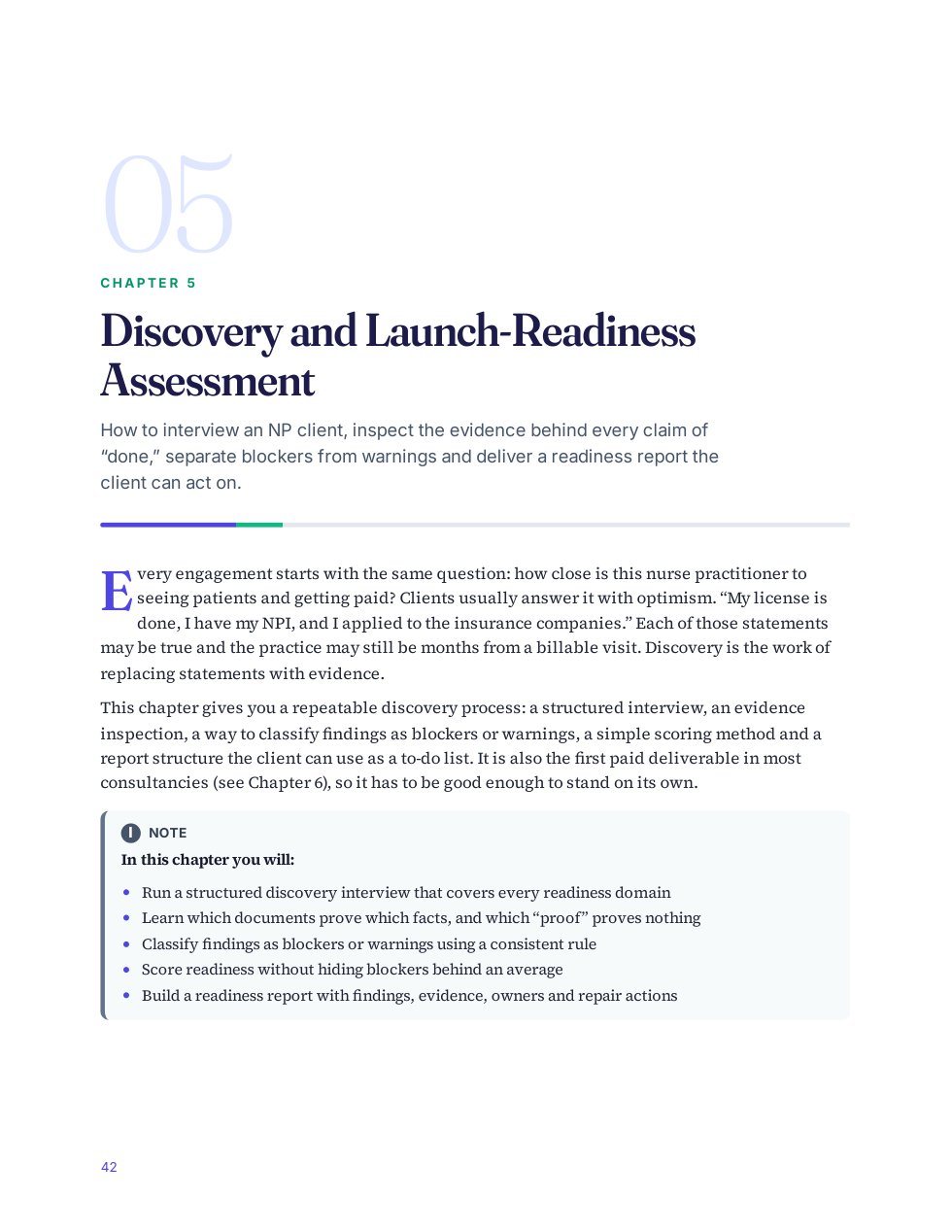
How to interview an NP client, inspect the evidence behind every claim of “done,” separate blockers from warnings and deliver a readiness report the client can act on.
Sample chapter from The Nurse Practitioner Practice Launch Consultancy Playbook (Credentik, 2026 Edition). Educational information only; not legal, tax, compliance, clinical or financial advice. Examples are fictional. Verify current rules with the agency, payer or your own professional advisers.
Every engagement starts with the same question: how close is this nurse practitioner to seeing patients and getting paid? Clients usually answer it with optimism. “My license is done, I have my NPI, and I applied to the insurance companies.” Each of those statements may be true and the practice may still be months from a billable visit. Discovery is the work of replacing statements with evidence.
This chapter gives you a repeatable discovery process: a structured interview, an evidence inspection, a way to classify findings as blockers or warnings, a simple scoring method and a report structure the client can use as a to-do list. It is also the first paid deliverable in most consultancies (see Chapter 6), so it has to be good enough to stand on its own.
Note
In this chapter you will:
- Run a structured discovery interview that covers every readiness domain
- Learn which documents prove which facts, and which “proof” proves nothing
- Classify findings as blockers or warnings using a consistent rule
- Score readiness without hiding blockers behind an average
- Build a readiness report with findings, evidence, owners and repair actions
Why discovery is separate from doing
It is tempting to start fixing problems on the first call. Resist it. Discovery is a snapshot; its value comes from being complete and neutral. If you start filing applications before you have seen the whole picture, you will fix the visible problem and miss the one that actually blocks launch, such as a practice location that the client has not secured or an entity whose ownership rules nobody has checked.
Keep three roles distinct from the first conversation:
- You (the consultant) gather facts, inspect evidence, identify gaps and propose repair actions.
- The NP decides what to do: which payers, which location, which services, how much to spend, when to open.
- Qualified professionals answer questions outside your lane: an attorney on entity, scope-of-practice and contract questions; a CPA or tax professional on tax; an insurance broker on coverage; a clinical professional on clinical protocols.
Your report should name the owner of each item using exactly those categories.
The discovery interview
Schedule 60–90 minutes and send the document request list beforehand (see the evidence table below). Use the same interview guide every time so you can compare clients and so nothing is skipped because the conversation drifted. Templates 1 and 3 in Appendix A give you a ready-made questionnaire, document checklist and readiness assessment.
| Domain | Questions to ask | What you are listening for |
|---|---|---|
| Vision and services | What services, for which patients, in what setting (in person, telehealth, both)? Which states? | Services that may need extra authority, settings that may need a facility license, out-of-state patients |
| Practice authority | Which state licenses do you hold? What does your state require for your practice model? Have you confirmed that with the board or counsel? | Assumptions about independence; practice environments differ by state [S01][S02] |
| Entity and ownership | Have you formed an entity? Who owns it? Who advised you? | Ownership structures that need legal review; no EIN yet |
| Location | Do you have a signed lease or a written commitment for the service address? | A “location” that exists only as a plan |
| Identifiers and enrollment | NPI type(s)? CAQH status? Which payers, applied when, and what did they say? | Confusing “applied” with “approved” or “contracted” |
| Systems | EHR, practice management, clearinghouse, phone, scheduling? | Systems chosen but not configured |
| Finances | Startup budget, cash reserves, expected payer mix, owner pay expectations? | No working capital for the enrollment and claims lag (Chapter 8) |
| Insurance and risk | Malpractice, general liability, cyber, workers’ compensation? | Coverage assumed rather than bound |
| Timeline | What date have you told people you will open? What is that date based on? | Dates promised to patients, landlords or lenders before enrollment is effective |
Tip
Ask “How do you know?” after every “yes.” The answer tells you which document to request.
Evidence inspection: what documents prove what
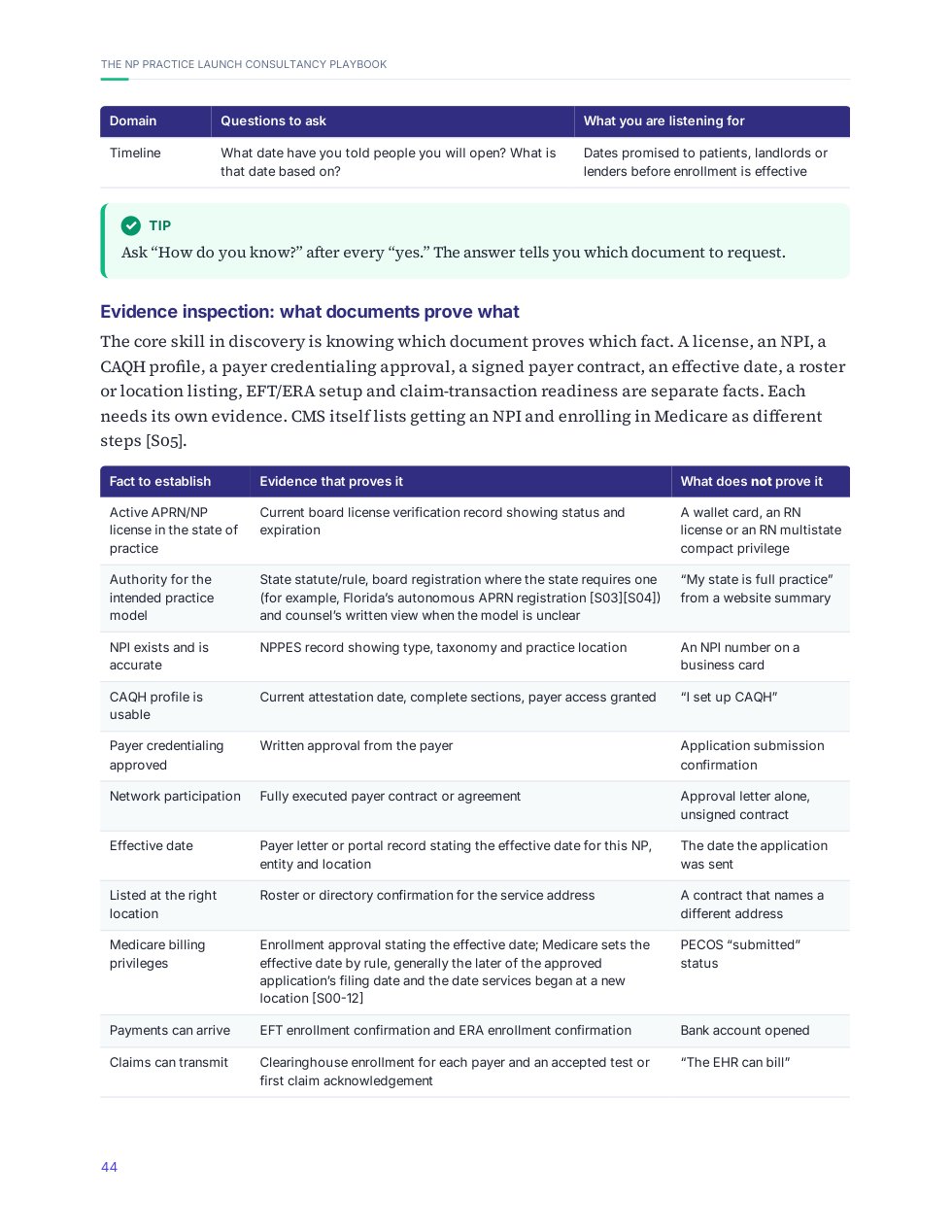
The core skill in discovery is knowing which document proves which fact. A license, an NPI, a CAQH profile, a payer credentialing approval, a signed payer contract, an effective date, a roster or location listing, EFT/ERA setup and claim-transaction readiness are separate facts. Each needs its own evidence. CMS itself lists getting an NPI and enrolling in Medicare as different steps [S05].
| Fact to establish | Evidence that proves it | What does not prove it |
|---|---|---|
| Active APRN/NP license in the state of practice | Current board license verification record showing status and expiration | A wallet card, an RN license or an RN multistate compact privilege |
| Authority for the intended practice model | State statute/rule, board registration where the state requires one (for example, Florida’s autonomous APRN registration [S03][S04]) and counsel’s written view when the model is unclear | “My state is full practice” from a website summary |
| NPI exists and is accurate | NPPES record showing type, taxonomy and practice location | An NPI number on a business card |
| CAQH profile is usable | Current attestation date, complete sections, payer access granted | “I set up CAQH” |
| Payer credentialing approved | Written approval from the payer | Application submission confirmation |
| Network participation | Fully executed payer contract or agreement | Approval letter alone, unsigned contract |
| Effective date | Payer letter or portal record stating the effective date for this NP, entity and location | The date the application was sent |
| Listed at the right location | Roster or directory confirmation for the service address | A contract that names a different address |
| Medicare billing privileges | Enrollment approval stating the effective date; Medicare sets the effective date by rule, generally the later of the approved application’s filing date and the date services began at a new location [S00-12] | PECOS “submitted” status |
| Payments can arrive | EFT enrollment confirmation and ERA enrollment confirmation | Bank account opened |
| Claims can transmit | Clearinghouse enrollment for each payer and an accepted test or first claim acknowledgement | “The EHR can bill” |
| Coverage in force | Certificate or declarations page with dates, limits and named insured | A quote |
Watch out
Never mark an item complete based on a screenshot of a submission screen. Submitted means only that someone has the application. Record the submission date, but keep the item open until you hold the approval, contract or confirmation that actually proves the fact.
Blockers versus warnings
Classify every finding with one rule:
- Blocker: the practice cannot lawfully see patients, or cannot bill for or be paid for a planned service line, until this is fixed. Examples: no active license in the patient’s state, no authority for the intended model, no executed contract or effective date for a payer whose patients are already booked, no service location.
- Warning: launch is possible, but the finding creates financial, compliance or operational risk. Examples: CAQH attestation due in three weeks, no cyber coverage, a malpractice limit that may not meet a payer’s requirement, no written collection policy.
Two refinements keep the rule honest. First, a finding can be a blocker for one service line and not another. Missing commercial payer effective dates block in-network visits for that payer but not a cash-pay visit (subject to state law and the No Surprises Act good-faith-estimate rules for uninsured and self-pay patients [S10]). Write the finding that way. Second, legal and authority questions you cannot resolve are blockers until an attorney or the board resolves them. Do not downgrade them because the client is confident.
Scoring without hiding problems
A score helps clients see progress across repeated assessments. It must never average away a blocker.
How to calculate it
Domain score: 2 = evidence complete; 1 = in progress with evidence of progress; 0 = not started or no evidence.
Readiness score = sum of domain scores ÷ (number of domains × 2) × 100
Readiness status = “Not ready” if any open blocker exists, regardless of score. Otherwise “Ready with warnings” or “Ready.”
Example: scoring Coastal Bend NP Care (fictional practice)
Nine domains are scored: authority 2, entity 2, location 1, identifiers 2, payer enrollment 1, systems 1, finances 1, insurance 1, timeline 0.
Sum = 2 + 2 + 1 + 2 + 1 + 1 + 1 + 1 + 0 = 11. Maximum = 9 × 2 = 18. Score = 11 ÷ 18 × 100 = 61.1, reported as 61%.
Check: 18 × 0.611 = 11.0. Correct.
Because two blockers are open (no executed lease and no payer effective dates while patients are booked), status is Not ready even though the score is above half.
The readiness report
Deliver a written report within an agreed number of business days after you receive the documents. Use the same sections every time:
- Summary. Status (Not ready / Ready with warnings / Ready), score, number of blockers and warnings, and the three actions that matter most.
- Scope and limits. What you reviewed, what you did not, the date of the snapshot, and a statement that the report is operational, not legal, tax or clinical advice.
- Findings table. One row per finding (format below).
- Domain detail. Short narrative for each domain with the evidence inspected.
- Questions for professionals. A list of questions to take to the attorney, CPA, broker or clinical adviser.
- Dependencies and sequence. Which repairs must happen first (a location before a location-specific enrollment, an entity and EIN before a group enrollment).
- Evidence index. Every document received, with date and source.
Example: findings table for Coastal Bend NP Care (fictional practice)
| # | Finding | Type | Evidence inspected | Owner | Repair action |
|---|---|---|---|---|---|
| 1 | Service address not secured; lease unsigned | Blocker | Draft lease, unsigned | NP decides; attorney reviews lease | Execute lease or written commitment; then update NPPES and applications |
| 2 | Two commercial payers show “application received” only; patients booked from next month | Blocker (in-network visits for those payers) | Portal screenshots dated last week | Consultant follows up; NP decides on rescheduling | Obtain approval, executed contract and effective date; do not book in-network visits until held |
| 3 | Practice model may need state-specific registration | Blocker until resolved | Board website printout; no counsel opinion | Attorney | Obtain written legal view; file any required registration |
| 4 | CAQH attestation expires in 21 days | Warning | CAQH profile summary | Consultant prepares; NP attests | Re-attest before expiration |
| 5 | ERA enrollment not done for Medicare | Warning | EFT confirmation only | Consultant | Submit ERA enrollment; confirm receipt |
| 6 | No cyber coverage quote | Warning | Insurance summary from client | Insurance broker | Request quote; NP decides |
| 7 | Startup budget has no working capital line | Warning | Client spreadsheet | NP with CPA | Build cash-flow model (Chapter 8) |
Consultant workflow
- Send the engagement letter, document request list and interview guide.
- Hold the interview using the domain table; record “how do you know” answers.
- Log every document received in the evidence index, with date and source.
- Verify what can be verified from primary sources (board license lookup, NPPES record, payer portals with the client’s authorization).
- Classify each finding as blocker or warning and assign an owner category.
- Score each domain; apply the blocker override.
- Draft the report, including questions for professionals.
- Review the report with the NP; confirm the NP’s decisions in writing.
- Agree whether the next step is launch management (Chapter 6) or a re-assessment after the client completes repairs.
Evidence and deliverables
| Step | Proof it is done |
|---|---|
| Interview | Completed interview guide with date and attendees |
| Evidence inspection | Evidence index with each document’s date and source |
| Classification | Findings table with type and owner for every row |
| Report delivery | Report sent, with delivery date |
| Client decision | Written confirmation of the NP’s decisions and next step |
Common mistakes
- Treating “applied” as “approved,” or “approved” as “contracted and effective.”
- Accepting an RN compact privilege as evidence of APRN authority.
- Averaging scores so that a blocker disappears into a respectable percentage.
- Giving a legal opinion on practice authority instead of routing it to counsel.
- Promising an opening date in the report. Report dependencies, not dates.
- Leaving the owner column vague (“TBD”). Every finding has an owner category.
Closing checklist
- Interview guide completed for every domain
- Every “yes” backed by a named document in the evidence index
- License, NPI, CAQH, approval, contract, effective date, location, EFT/ERA and claim readiness recorded as separate facts
- Each finding classified as blocker or warning, by service line where relevant
- Unresolved legal or authority questions treated as blockers and routed to counsel
- Score calculated and checked; blocker override applied
- Report includes scope, limits and the non-advice statement
- NP’s decisions confirmed in writing
Key takeaways
- Discovery replaces statements with evidence. Ask “How do you know?” after every yes.
- Each launch fact has its own proof. A submission is not an approval, an approval is not a contract and a contract is not an effective date.
- A blocker overrides any score.
- Every finding needs an owner: consultant, NP, attorney, CPA, broker or clinical professional.
- Report dependencies and repair actions, never guaranteed dates.
Sources cited in this chapter
- [S01] State Practice Environment, AANP. https://www.aanp.org/advocacy/state/state-practice-environment (accessed 2026-10-11).
- [S02] Practice Information by State, AANP. https://www.aanp.org/practice/practice-information-by-state (accessed 2026-10-11).
- [S05] Advanced Practice Non-Physician Practitioners, CMS. https://www.cms.gov/medicare/payment/fee-schedules/physician-fee-schedule/advanced-practice-non-physician-practitioners (accessed 2026-10-11).
- [S03] F.S. 464.0123 Autonomous practice by an advanced practice registered nurse, Florida Legislature. https://wwwo.leg.state.fl.us/statutes/index.cfm?App_mode=Display_Statute&URL=0400-0499/0464/Sections/0464.0123.html (accessed 2026-10-11).
- [S04] Applying / registration requirements, Florida Board of Nursing. https://floridasnursing.gov/applying-requirements/ (accessed 2026-10-11).
- [S00-12] 42 CFR 424.520 Effective date of Medicare billing privileges, CMS (via Cornell LII). https://www.law.cornell.edu/cfr/text/42/424.520 (accessed 2026-10-11).
- [S10] No Surprises Act provider requirements and resources, CMS. https://www.cms.gov/initiatives/no-surprise-billing/overview/policies-resources/provider-requirements-resources (accessed 2026-10-11).